RHYTHM HYPOTHESIS
Rhythm as Relative Temporal Structure
Introduction
Rhythm can be understood not only as a sequence of audible events, but also as a relationship between multiple temporal structures.
I propose that periodic structures, their relative displacement, and the continuous motion between rhythmic reference points may contribute to how rhythm is perceived and performed.
A central idea of this hypothesis is that finer rhythmic subdivisions can be constructed by recognizing the extrema—high and low points—of multiple periodic movements. These reference positions may be perceived even when no sound occurs at them.
The same audible rhythm may therefore support different rhythmic experiences depending on how its underlying temporal structures are organized and perceived. This proposal is intended as one possible framework for exploring rhythmic relationships, rather than a universal explanation of musical rhythm.
1. Beat and Continuous Motion
1.1 The Beat as a Reference
A musical beat provides a recurring reference in time. However, rhythmic experience is not limited to the instant at which a beat occurs. A listener or performer may experience a continuous sense of movement between successive beats.
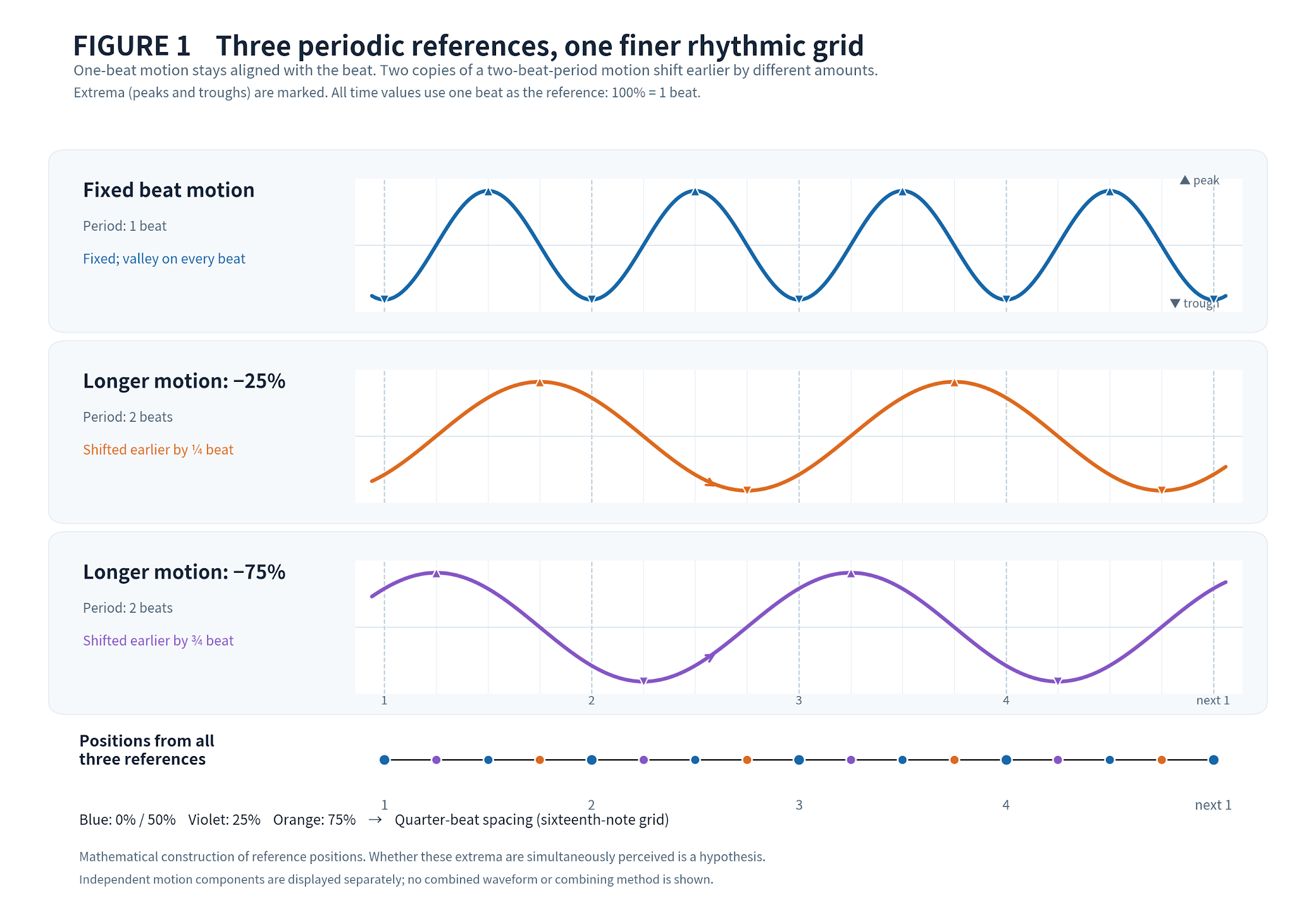
This movement can be represented by a periodic structure with alternating high and low points. In the model considered here, a one-beat-period movement has a low point at each beat and a high point halfway between beats. These two types of extrema establish reference positions at intervals of half a beat.
1.2 Audible and Perceived Subdivisions
The positions used to organize a rhythm do not necessarily correspond to audible events. A performer may maintain an internal sense of eighth-note or sixteenth-note subdivisions while producing fewer sounds.
The distinction between sounding a rhythmic position and perceiving it as a temporal reference is fundamental to this hypothesis.
2. Temporal Displacement and Rhythmic Grids
2.1 Why Shift a Periodic Structure?
Temporal displacement changes the relationship between periodic movements without necessarily changing the audible rhythm. By maintaining one periodic structure as a reference and shifting another relative to it, additional temporal positions can be established.
The purpose is not simply to move musical events, but to explore how multiple temporal references can coexist within the same rhythmic pattern.
2.2 Two Different Periods
Consider two periodic structures. The first completes one cycle per beat. Its high and low points occur at half-beat intervals. The second completes one cycle over two beats. Its high and low points occur one beat apart.
By shifting the second structure relative to the first, its extrema can be placed at different positions within the beat. This provides a simple example of how rhythmic reference positions may arise from relationships between structures of different periods.
2.3 Constructing a Sixteenth-Note Grid
Let one beat represent 100% of the reference duration.
The extrema of the one-beat-period structure occur at 0% and 50% within each beat.
Now consider two separate two-beat-period structures, displaced relative to the original reference. With a displacement of −75%, their extrema occur at 25% within each beat. With a displacement of −25%, their extrema occur at 75% within each beat.
Considering the extrema of all three structures together gives 0%, 25%, 50%, and 75%: the four positions of a sixteenth-note grid within one beat.
This construction does not require all four positions to be sounded. It establishes a possible set of internal rhythmic references. The two displaced structures are a mathematical illustration and do not imply that a particular app simultaneously combines both offsets.
Figure 1 — Periodic Motion and Sixteenth-Note References
2.4 Individual and Integrated Perception
I propose that multiple periodic structures may be experienced in more than one way. They may be perceived individually, with the extrema of each structure providing distinct rhythmic reference positions. Alternatively, their relationships may be experienced as a single, integrated sense of continuous movement.
These possibilities are not necessarily exclusive. A performer or listener may alternate between them or experience aspects of both simultaneously. The construction of the reference positions is mathematical. Whether these forms of perception occur, and under what conditions, remains a hypothesis requiring investigation.
2.5 Relative Phase and Rhythmic Experience
Different phase relationships can preserve the audible timing of musical events while changing the organization of the underlying temporal references. Even when the same reference positions are present, their relationship to the original beat and to the direction of continuous movement may differ.
I hypothesize that these differences may contribute to distinct sensations of rhythmic movement, emphasis, and continuity. The existence of different mathematical phase relationships does not, by itself, establish different perceptual experiences.
3. Meter and Rhythmic Grouping
3.1 Meter as a Larger Temporal Structure
Musical meter organizes beats into recurring groups. These groupings provide temporal references extending beyond the duration of an individual beat. The principle of temporal displacement can be considered within different meters, provided that the reference beat, periodic structure, and displacement are clearly defined.
3.2 Four-Beat Meter
In four-beat meter, the one-beat-period structure can remain aligned with each beat while longer-period structures establish relationships across multiple beats. Their relative displacement may create additional rhythmic references without changing the four-beat organization.
3.3 Triple Meter
The same principle can be extended to three-beat meter. A three-beat cycle provides a different organization of temporal relationships, particularly at the transition between measures. Periodic structures can be displaced relative to this grouping, potentially producing different orientations of continuous movement.
However, numerical phase relationships developed for four-beat structures cannot automatically be assigned the same musical meaning in triple meter.
3.4 Compound and Irregular Meters
The principle may also be applied to compound and irregular meters. In such cases, the beat unit, subdivision, grouping, and reference period must be distinguished. The general operation remains the relative displacement of periodic structures, while its musical interpretation depends on the selected temporal organization.
4. Swing and Unequal Subdivisions
4.1 Equal and Unequal Intervals
In straight eighth-note subdivision, the beat is divided into two equal intervals. In swing, the subdivision position changes, producing unequal intervals within the beat. This changes the temporal relationship between the beat and its subdivision.
4.2 Subdivision and Relative Phase
Changing the subdivision ratio and shifting a periodic structure are distinct operations. The first changes the internal timing of subdivisions. The second changes the relative position of a temporal structure. These operations may be considered independently or together.
4.3 Extension of the Hypothesis
I propose that the relationships between periodic movement, unequal subdivisions, and relative phase may contribute to the experience of swing and other forms of nonuniform rhythmic timing. The model does not assign a universal rhythmic sensation to any particular subdivision ratio or phase displacement.
5. Continuous Motion and Rhythmic Experience
5.1 Position and Direction
A rhythmic reference can be considered not only as a position in time, but also as a point within an ongoing movement. An event may occur while a movement is rising, falling, approaching an extremum, or moving away from it. These relationships provide information that is not represented by event timing alone.
5.2 The Relationship Between Motion and Sound
Musical performance often involves continuous bodily movement organized around discrete audible events. Instrumental gestures, walking, dance, and conducting provide possible examples of this relationship. I hypothesize that the orientation of continuous movement relative to audible events may contribute to how rhythmic emphasis and continuity are experienced. These correspondences are not assumed to be universal.
5.3 Multiple Temporal Structures
The experience of rhythm may involve several periodic structures operating at different temporal scales. Such structures may be experienced separately or as part of a larger, integrated movement. Their relative phase, periodicity, and orientation may provide additional ways of organizing musical time beyond the audible sequence of events.
6. Scope and Limitations
The construction described in Figure 1 demonstrates that the extrema of selected periodic structures can establish equally spaced sixteenth-note reference positions. This is a mathematical property of the proposed construction.
Whether human listeners or performers perceive these structures simultaneously, or experience their relationships as integrated movement, has not been established through controlled experiments.
The hypothesis does not claim that all rhythmic perception is generated by periodic motion or temporal displacement. Nor does it claim that periodic structures, phase relationships, or rhythmic subdivision are themselves newly discovered concepts. The proposal concerns their possible role in the organization and experience of musical rhythm.
Conclusion
Rhythm may be understood not only as the timing of audible events, but also as a relationship between multiple temporal structures.
The extrema of periodic movements can establish rhythmic reference positions, while relative displacement changes their organization within a common temporal framework.
A one-beat-period structure, together with appropriately displaced two-beat-period structures, provides a concrete example of how sixteenth-note reference positions can be constructed without requiring every position to be sounded.
The central hypothesis is that multiple periodic structures may be perceived individually or as an integrated continuous movement, and that their relative relationships may contribute to different rhythmic experiences.
This framework is presented as a musical hypothesis for further investigation, not as an experimentally established theory of rhythm perception.